Words and Meanings
How could I not get back to that footnote of the previous post? Word salad and euphemisms no matter where you look!
So I had already grumbled about the peculiarity of "a software calling home" meaning absolutely nothing but bullshit and hogwash these days. I suppose the actual insight came while seeing a mobile phone connect to a local home router. Yes, sure, it found 'home', as in, the actual home of the person connecting their phone... and I thought, "hey, that's what 'calling home' should mean." But no matter how you look at it, the prevalent use of that term is akin to "a company's product is sending telemetry to their servers, and/or, but not limited to, whoever else of the affiliated partners may in this or that constellation have an interest in your data."
And so I sometimes do wonder if these word choices are mere coincidence, or if I want to read carefully pruned damage control/image control into it. Do we just not think about it too much because the word 'home' is so cozy? If so, that's remarkable wordfuckery.
It is just as admirable how "to google something" has become a generic brand name up to the point of yielding its own grammar, which can't be said about all products attaining this linguistic blessing. People don't anymore just search. I think we should do it again, sounds silly, but that's what it boils down to. The word with 'g' we'll reserve for the unreliable mess of an algorithm driven hellhole that the Search Engine Company supplies us with. Lots of marketing money went into establishing that brand lingo in your mind. Marketing doesn't have to only sell products, its elevated function is nudging that little recognition effect in people.
Nudge Nudge
Dark patterns are particularly insidious for nudging the user with just the right tone (thinly veiled shame and guilt, for starters) towards the company's desired behaviour. It's a bit more complex than the lever which a lab rat pulls, but the entire setup isn't all that different once you look at hard sell and soft sell tactics. Anytime the target consumer thinks about, say, the Search Engine Company's name, that thought can connect to all the other products, perhaps something that already stands at home or is being used in a digitally ethereal manner. That Search Engine Company started out as mere internet asset after all.
Now it's a physical presence in way too many places. But, if nothing else, the slogans and product names sit now as a memetic earworm of sorts in the target audience's mind, ready to be nudged again. The special bullshit award goes out for how they'll sell you all that nudging and its effects as being what you wanted, and that it's really for the common good that the company does things the way it does. Did you click "AGREE" already, or "LATER"? That "later" instead of a simple "no" is a dark pattern too. Threat and Reward, Bait and Switch, old strategies and tactics in more digital form. Again, that of course simplifies a lot at once here, but let's not forget market analysts argue with simplified models and market predictions too... and they are eager to replace the customer evaluation and surveys with so-called "synthetic participants". Yet another simplification that currently runs into walls. People are not LLMs nor AI agents.
On the other hand, some users and market players are already perpetually high on Googlium, a dangerous street drug sold by cyberpeddlers in dark alleys billion dollar advertisement companies, who in turn pour billions into the Search Engine Company's ranking blessings... well. If you want to, you can also imagine it like a big boss sitting there, cigar in mouth, wandering through the business and tossing the storefront shelf over. "Shame if something would happen to it," he grumbles, tipping the ash off on your pristine wares before going on, "Your customers wouldn't see your storefront so prominently, right? Imagine a bit more ash." He'll extinguish half of a perfectly fine cigar on your store shelves, smoke curling up. "But for the right price, my hired buddy Al Gorithm will step aside from the window and even tell 'em folks on the sidewalk how amazing your goods are!" Together with the nudged pedestrians, that paints a rather ugly picture.
So perhaps we should call that business practice by its gerund of 'Search Engine Company' -> 'to Search Engine Company something or someone'. Seems fitting. If business practices go with the times, its only fair that so does language. If the word choice isn't coincidence, but a carefully planned marketing campaign with a topping of Sauce Bernays, let's answer in kind. Summing it up: "to Search Engine Company someone/something", v. - racketeering, extortion, mafia methods; compare -> "to search", v. - searching for sth., often also online in these modern times of to-day ...there, easy as that.
Have we as a society already considered how utterly disdainful the practice of branding (!) people as a target of any kind really is? Phew. I thought we'd overlooked something, you know, generally speaking, just about society-as-whole terminology that has become accepted. Marketing cokehead lingo is unsalvagable, sorry, not even the invisible hand of the market will be able to help that clusterfuck.
Footprints by the Craters of Giants
But "to apple/pear something" has, curious enough, not made it into common language. In fact, a little startup Search Engine Company pays the little startup company Crapple some stout sum, just so that their Search Engine Company product is the preinstalled, preferred, and preconfigured search of not-choice on Crapple products. One hand washes the other, but sometimes the realization sets in that to clean one thing, something else must become dirty. The laundry water is downstream with the users.
For a while, Microslop was busy trying to establish itself as a portal to the world, Internet Explorer by default, and at the time they were really big on making their slogan "where do you want to go today?" But as time and browser wars went on, the Iex became also synonymous with "browser you use to install a better browser after installing the OS". Edge tries to remedy that, but "edging" has entirely different connotations, so maybe it's wise they're not pushing for the generic brand gerund nor do they follow other ambitions like it.
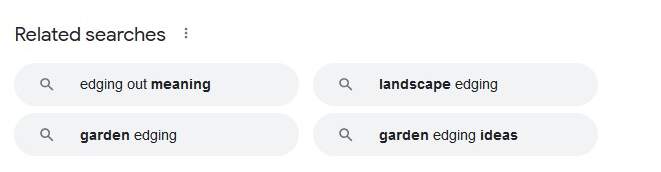 Even the Search Engine Company can't help with Edging, it seems.
Microslop is also really eager to stop the Microslop association, but, guys, then just deliver a product without slop. Easy. Instead the user is being subjected to all-integrated AI shenanigans, with a CO2Pilot cosplaying real hard that it is its own thing and not powered by another company's LLM. While users are despairing over where the fuck the options to turn it off are hidden now again, the CEOs will tell the users to please use all that compute responsibly. Yeah, sure. Do they come up with that kind of wisdom themselves or do they ask their AI to formulate the slop?
Big Oil did a fantastic job at establishing the idea of a CO2 footprint being something that is imaginable, just the size of an imprint in the snow or dirt, about the length of a foot, though not necessarily Imperial. The exploitation business of resources and its connection to Imperialism of the past is another problem, so let's not dwell here too long. But in essence the suggestive power of a footprint, human as a foot certainly must be in common parlance, is that it is an individual being's responsibility. Certainly the footprint which you, Dear Citizen, should reduce, is much more worrisome than the giant craters and sludge pits which full blown industries are creating next to, Dear Citizens, your feebly imprinted pseudopodiae. In consuming the industries' output, the Dear Citizen acts also as a consumer, and thus amplifier of that crater. So there is a footprint after all... but responsibility and blame have shifted substantially when so did the verbiage.
The "Invisible Foot of the Market" should be an established term too, I suppose.
CVE-01-02-MANY
A similar shift-of-blame happens if you've ever been subjected to the email of some service or the other you signed up with, alerting you to a recent breach of security, a trove of user data ferried out, etc. pp. yadda yadda. Oh, how wonderful. Then you know upon reading the nonsense that the service and its company did their best, pinky promise, to keep the data safe, but these ravaging hackers with criminal instinct really dared to carry the plaintext stuff out through the front door. Now, Dear Citizen User, you should hurry up and do your part, change these compromised passwords now.
The further flow of information is sparse, a press speaker or two may have to be ritually butchered, but after that it's back to business as usual. A user, curious about which loophole was exploited this time around, might shudder in sheer terror upon seeing the lists of open CVE (Common Exploits and Vulnerabilities), with rat tails of grandgrandgrandfathered libraries and dependency hells. That is not a problem with any single one company either, it's a systemic problem in maintaining the technical world we've built up. It's prestigious to write fancy new code. Maintaining the old mess and auditing it with advanced tools anew is not particularly exciting. But that inconvenient truth wouldn't be one the customers want to hear, so the usual alert (!) will supposedly a) calm the user down, b) reassure them of the company doing their best they can to remedy the situation, and, c) convince the user to please change their login credentials.
You might even be so lucky to read something about the latest generation of AI code that is going to make it all better soon. Pinky promise it won't be slop, too.
 Slop Express leaking slop all over the place. Disgusting!
(NOAA, 1989, oil on aquarel, 1000s of sqm, colorized. https://commons.wikimedia.org/wiki/File:Exval.jpeg)

While few bat an eye when a software is said to "phone home", those in on the joke will outright flinch when they hear "degooglified device". "De-search-engine-companied device" doesn't really roll off the tongue so well... deshittified it is. Either way, that isn't even the thing to flinch over. The act itself means namely some-to-painfully-too-much-work. Nobody should have to deal with this opt-out/exit-out game dragging on longer than needed, and 'long' should mean the press of a button, ideally. Yet a majority of end consumer devices will be shipped with a complete bundle of operating system and pre-installed software absolutely needed for telemetry and Important Other Things. If the manufacturer/licensor/seller insists, their own soup is embedded too. Untangling the mess isn't always possible. Even if it is, that means hurdles to climb and time expense to justify, at times for technically somewhat outdated devices. Not everyone has that time nor patience to do the deshittification dance, let alone see the cost-benefit calculation.
If you've ever done it, you might nonetheless find yourself wondering if you could've not spent your time better with a device that just follows suit out of the box, without 'suit' implying a company dresscode kind of way. But then you might also know already that it's not like the choices are particularly overwhelming nor cheap.
Hail Eris! Hail Discoursia!
The first time I was invited to a Discord server, the terminology was a little confusing. It was obvious that there wasn't any real "server" to be had here, so let's pack out the alibi quotation marks again. For comparison, IRC has individual servers that may sure enough belong to a network, but they all can access the same channels of that network. On Discord, however, the "serverspace" is going to sit on Discord's server farm, sharing its presence with a few other "servers" on a rack. The hyperscaling for that to work goes quite some lengths, and is perhaps Discord's greatest technical achievement. But let's dissect that soon a little...
...at the time I was curious what other "servers" there'd be, but lo and behold, Discord had at the time not exactly thought about provisions for finding anyone else's servers in a convenient manner. That led to a whole own universe of websites springing up to list servers and their activity, and an entire subuniverse of bots was spawned forth too, so that server owners could bump their presence on these third party lists. On IRC meanwhile, a click suffices to be in the loop with all non-secret channels present on the network.
Granted, IRC comes with its slow and sluggish pace. It's not exactly media-rich, unless you throw the right mixture of client and scripts at the problem, but of note is surely that IRC being a protocol means you have a choice which client to pick. Also, slow pace, yes, long idle periods, yeah, yeah.
And now you got to wonder if that is any better on the dozens of servers you might have added on Discord? Instead of a single channel that occasionally wakes up when their favourite topic is mentioned, you now have a whole lot of these "servers" with channels branching out into several sub-fields. Nearly every of the places will have your typical meme channel, official, offtopic, and a bunch of theme-specific ones. The real headscratcher is that all of them could coexist. You could sit on some IRC network(s) of your choice, frequent the cat meme channel, the next channel for your favourite hobby, and still hang out on a smaller channel shared with friends. It'll still mean a sidebar (or other layout) with networks and channels listed, but they're still all in sight at once without each and every one of them branching off into ten variations on a theme.
Ping timeout - Netsplit
The way Discord works, you'll be instead tabbing to and fro between layers and layers of servers and channels to keep an eye on your regular interests. Instead of sharing your cool find once in the right channel, you'd end up crossposting it here and there. And I haven't even gotten started about the terrible choice of some communities to put their entire knowledge base, previous forum structure, or otherwise handy info right into what Discord deems a solution for storing and retrieving sorted information: though Discord does have a fairly complex search function, it doesn't allow for cross-server searches. It isn't anywhere near a solution if you'd measure the entire universe, that's how far off it is. It sucks majorly because it's all non-searchable outside of Discord's ecosystem.
So if you had a quick question in Ye Olden Days, you could find an IRC channel for that community/group/enthusiast circle, and with a quick click on the IRC web edition you'd land as "guest33523" or something thereabouts in the intended channel, no signup necessary (though some networks allow nicknames to be registered). If you'd done it a few times, you probably had an IRC client anyway. That meant that your information or feedback channel was available without any signup. Enter a nickname, off you go. Nowadays, though, we must but wonder how much info is out there which you can't get without a Discord account. So, let's say you finally caved in, and you're ready to follow the invitation link. Can you also get onto the intended server without needing to send your phone number, ID, and perhaps your butt print? These settings vary per "server", after all, though Discord itself is under crossfire for other badly aged gatekeepery as well. IRC doesn't have any provisions in its protocols to enforce anything of the sort by itself. The concept of Free Information gets tricky when you're handing over more data than you're willing to part with, is the point.
When there's dissent about Discord, as happened the last few times about their age gate ideas, there isn't a single unifying place for discontent to unfold. Every server mutters a bit to itself, and that was it. A storm in a waterglass comes to mind, though we're rather looking at a vending machine full of water glasses with a tiny bit of storm each.'
To keep up with only one field of interest, you'll end up on five "servers" with degrees of activity varying from "none whatsoever" to "full insanity mode". Now you can go and toss the four least appealing/busy/meme-y ones aside... or you'd mute them. Either way, both choices aren't exactly optimal. There's only a small chance you'll ever figure out if that particular bit of information you sought will maybe crop up here or there, or if it already did in a place the internal search does not cover. Considering the vast scaling Discord's actual server infrastructure performs to store and track all messages, they could do better...
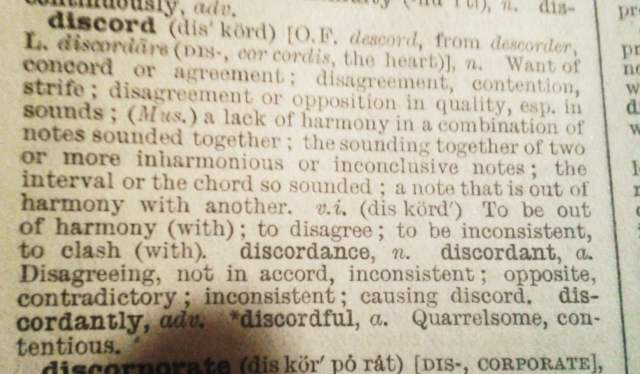 The dictionary is quite clear about this one.
But back to names and meanings and the thought that struck me most after I'd gone through with the Discord invite (another quirky feature, isn't it?). I found "Discord" a quizzical choice of name for a chat program. Had they meant "Discourse", perhaps? Or did they mean to call it "Concord"? No, the loading spinner (terrible invention, that, too) informs me that originally they had another idea, which they ditched, so the choice for Discord was certainly intentional. The money quote comes from their top rank, who manages to say something along the lines of "we picked 'Discord' because it has something to do with communication", and yet acknowledges "the project goal was to overcome the discord in (game-)chat communities". Now it's even more intentional.
Mixed messages, once again, mixed messages,... I don't know how to put a finger on it, but there's a strange discrepancy between the proclaimed goal, and what is being achieved. Instead of getting rid of the problem, they've built a nice systemized version of discord, with fragmented information that is yet preciously centralized. Are they really sure they didn't mean to choose the antonym?
It's probably time to read the Principia Discordia again.
No, there is no footnote to this post, though loading spinners deserve one.